
Pimlical Android Help
Tasks View
The Tasks View uses
an event selection list to display Tasks (and/or Floating Events) in a
dedicated list that is not constrained to being in a chronological
order. It also uses the Due Dates for organizing by date (as opposed to
the display date which is used in a view) and has convenient buttons
for quickly changing the priority or urgency of an event. Some of this
can be accomplished of course by using a filter that displays tasks
with the Find function, but the dedicated Tasks View provides a more
convenient way of managing tasks.
Invoking the Tasks View
To invoke the Tasks View, use menu | Tasks View.
You can also put this menu item on the Command Bar as a button (to do
that, go into menu | Preferences | Commands/Functions and pick one of
the preference items for the Command Bar - such as CommandBarViewButton1). The Tasks View will display a Thumbtack icon(  ) on the command bar.
The tasks that are displayed in the Tasks View are controlled by a Pimlical Filter. The default filter is Tasks_Only and this is set in the preference: DefaultTasksViewFilter. After the view appears, there is a Filter
button that you can tap to select a different filter. You should only
select filters that display Tasks and/or Floating events. In addition
to the Filter button are buttons to create a new Task or to bring up
the Template Selection List (which will only show tasks (and floats if
the current template is set to display floats) in the template list).
The Tasks View appears as an Event Selection List with the addition of two large buttons for the Priority and Urgency.
You will typically want to set the preference SelectionlistIconStatusSize to a larger value than SelectionListIconSize
so that the checkbox for the task (or circle for a float) is easily
selectable to mark an item as completed (or incomplete). If you only
want to change the size of this icon for the Tasks View, you can always
attach a custom preference file to the Tasks_only Filter and change it
just in that preference file.
Items displayed in the Selection List of Tasks/Floats
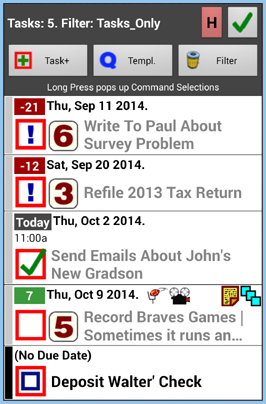
At top right is the Hide/Show
button which can be used to alternately hide or show items that are
currently being hidden by the filter. The button with the Green
CheckMark exits the Tasks View.
On the line below is a button to
create a new task (and a long-press on that button will create a
floating event), a button to bring up the quick entry templates (only
those templates that create tasks or floating events (if the filter
displays floating events) are displayed in that list. Finally, there is
a Filter button that allows
you to select different filters for this view. The filter list only
displays those filters that include tasks and/or floating events. To
set a filter as the permanent default for the Tasks View, set the
preference: DefaultTasksViewFilter to the filter you want to use.
On
the line below that are two buttons, the multi-select button which
allows you to select two or more tasks and apply popup commands to all
the selected item, and the Master/Subordinate Control button which, if
you are using Master/Subordinate Tasks, allows you to display just
Master Tasks, Master Tasks and their associated subordinate Tasks, and
all tasks.
In
the left margin of every row is a tall, thin, vertical bar that shows
the default color of the category that the item is assigned to (default
colors for categories are set in menu | Select Categories).
At
top left, If the Task/Float has a due date, the days past-due or days
till the due date are displayed in a colored box - red if the
item is past-due and green if it is due in the future. Items due today
show Today with a dark gray background.
Next on the top line is
the due date if the task or float has a due date, followed by any
user-assigned icons, and any system icons. If there is no due date for
the item, then (No Due Date)
is displayed for the item. Any system icon can be tapped for additional
information about the event. If the Task is timed, the starting time
for the task is displayed immediately below the due-date box.
On
the next row is the Status icon for the Task (Checkbox) or Float
(Circle) which can be long-pressed to toggle the status setting between Completed and Normal status. This
is followed by the Priority and Urgency
buttons for the event. By default, the buttons are only shown if the
Priority or Urgency has been set for the item, but you can force those
buttons to always display by setting the preference: HidePriorityUrgencyButtonsIfNotSet to false. The order of the two buttons is governed by the preference: ShowUrgencyFirst
which can be set to true or false). Following the buttons is the
description of the Task or Float. This can optionally include the
location and note associated with the item (depending on preference
settings), and the number of lines displayed is controlled by the
preference: MaxLinesInTasksView. In addition to the description, the category, location and note will also be appended depending upon the preference settings (IncludeCategory, IncludeLocation, and includeNote).
Sorting Tasks
Tasks are sorted based upon the settings in the filter. To change the sort, tap on the Filter button and select the filter you want to change. Go into the Sort tab (  ) and change the sort criteria. Note that you can sort on any one of a dozen criteria (due date, icon, category, status etc.) and
on a dozen levels. In other words, if you pick due date as the first
sort criteria and two items have the same due date, Pimlical then
compares the two items based upon the second sort criteria, and if
those match, it proceeds to the third sort criteria, all the way down
to the very last sort criteria (and if that matches, the items are then
sorted by uniqueID in order to ensure a stable sort that always
displays the items in the same order).
) and change the sort criteria. Note that you can sort on any one of a dozen criteria (due date, icon, category, status etc.) and
on a dozen levels. In other words, if you pick due date as the first
sort criteria and two items have the same due date, Pimlical then
compares the two items based upon the second sort criteria, and if
those match, it proceeds to the third sort criteria, all the way down
to the very last sort criteria (and if that matches, the items are then
sorted by uniqueID in order to ensure a stable sort that always
displays the items in the same order).
Unlike
main views, the Task View can display Tasks without the forced,
chronological ordering which always applies to the display of events.
Often, you may want to sort by Priority or Urgency before sorting on
the basis of due dates and if that is so, you definitely want to use
the Tasks View as it allows you to do that.
The default sort for most types is Ascending, but there's an exception for Urgency and Priority where the default sort is Descending. In the case of Priority and Urgency the Sort Direction refers to the Priority or Urgency level not the designations we use to represent those levels of priority and urgency. So in the case of priority, Descending
means descending from the highest priority (designated by the number 1)
to the lowest priority (designated by the number 9), even though the
designations will actually be "Ascending" from 1 to 9).
Master and Subordinate Tasks
As
with events and templates, you can create a group of tasks which
consist of a Master Tasks and one or more Subordinate Tasks. The reason
for doing this is that you can easily hide the Subordinate Tasks and
just display the Master Tasks. By default, when all tasks are being
displayed, Subordinate Tasks are always hidden. So to see Subordinate
tasks you have to tap the Master/Subordinate selection button at the
top of the screen and tap the Master + Sub. button.
If you long-press a Master Task in the Tasks View, you can use the popup command Find All Link Events to
display the Master Task and all of its Subordinate Tasks. At that point
you can long-press the Multi-Select button to select everything and
then long-press any item to popup the command list. Useful things might
be to Delete (which would delete the Master and all the Subordinate Tasks), or Shift Times Forwards/Backwards which would move everything uniformly as a group.
There
is no provision in Pimlical for handling a hierarchical tree of
subordinate tasks, but handling simple, hierarchical subordinate tasks
is possible by using the Urgency field. So the most important
Subordinate Tasks would be set at Urgency A, the next most in Urgency
B, etc. By judicious setting up of additional filters, you could
quickly choose to just show Urgency A, or show A & B etc.